Ella and Martin's romantic relationship
You Should Have LeftElla and Martin’s romantic relationship is the central new pairing in the film project being developed within the narrative, and it is defined from the outset by displacement: Martin is Jana’s former boyfriend, while Ella is the friend who asks Jana to leave the apartment so that Martin can move in. What first appears to be a straightforward transition from one couple to another instead exposes the instability beneath romantic reassignment. Martin’s professional identity, Ella’s defensiveness, and the couple’s inability to speak plainly make their relationship a testing ground for the book’s larger concern with intimacy, performance, and the fear that ordinary domestic life can suddenly become unrecognizable.
Formation Through Displacement
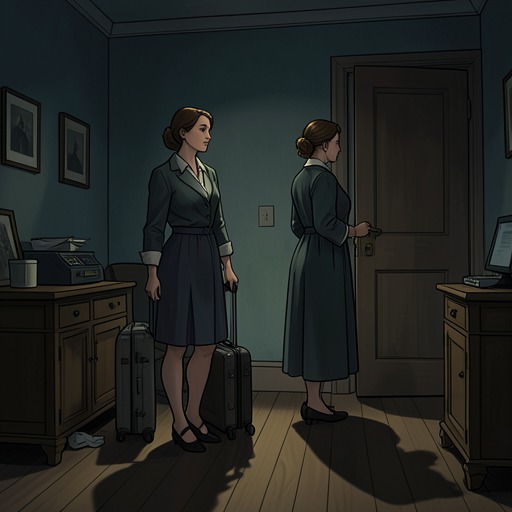
Ella and Martin are presented as the new couple in the sequel to an earlier film, where the established characters now require additional backstory. The narrative deliberately refuses to supply a conventional childhood history for Ella or Jana, and instead makes the relationship legible through its immediate social consequences. Ella asks Jana to move out of the apartment where Jana lived in the previous film because Ella’s new boyfriend, Martin, is moving in. Martin is therefore not an unknown newcomer but Jana’s ex-boyfriend, and the new relationship carries the residue of an earlier one before Ella and Martin have even been shown together.
Jana explains that she and Martin broke up because he was not right for her, not because he lacked attractive or admirable qualities. He is described as good-looking, sensitive, well-read, and multilingual; the decisive obstacle is his occupation as a senior tax official. Ella’s relationship with him consequently appears to overturn Jana’s judgment. The same profession that once made Martin unsuitable for Jana is now treated by Ella as compatible with love, creating a quiet rivalry between the former relationship and the current one. The arrangement also gives Ella’s request to Jana a material edge: romantic change requires a change of residence, so emotional succession is enacted as eviction.
Conflict at the Apartment
Jana’s response to being told to leave is unexpectedly calm. Everyone anticipates an outburst, but none occurs, and her composure itself provokes Ella. Ella interprets Jana’s calm not as acceptance but as an insinuation, as though Jana’s lack of anger exposes something about the new couple’s legitimacy. The exchange turns on whether Jana ever wanted to live there anymore and on who has the authority to define what her departure means. Ella’s irritation grows precisely because Jana refuses to provide the dramatic reaction that would justify Ella’s own anger.
The argument then narrows onto Martin’s work. Ella asks whether Jana’s objection is that he works for the tax office. Jana answers that it is a job like any other and argues that the state cannot function without tax officials; without streets, she says, there would be anarchy. Her defense is rational and almost civic-minded, but Ella hears in it the tone that has always made Martin, and perhaps Jana, difficult to accept. Jana finally states that Martin was simply not right for her but is clearly right for Ella. The distinction sounds generous, yet the scene does not resolve the tension. Martin enters wearing a suit and carrying a briefcase, and Ella redirects her rage toward him under a pretext while Jana stands nearby without smiling. His arrival converts an argument about an absent man into a confrontation with the man who embodies the couple’s new arrangement.
Domestic Intimacy and Performance
Martin’s professional identity becomes a source of private self-doubt. After the fight, he goes to the office and recognizes in his colleagues what other people see in him: tax officials. Looking at photographs from his school years, he notices that he was once not yet a tax official; university photographs show the transformation beginning through a tie, solemn concentration, and devoted attention to crossword puzzles. He loosens his tie and immediately feels insecure, then tightens it again. After seeing a casually posed pop singer in a magazine, he orders a tax audit of the singer and slowly loosens his tie once more. The action is both petty and revealing: Martin cannot escape his bureaucratic identity, but he can momentarily perform rebellion through the authority that identity gives him.
The relationship’s domestic life is likewise organized around performance. One morning Ella and Martin lie beside each other and pretend to be asleep. Martin watches Ella awaken, closes his eyes when she looks at him, and later imitates waking after she has closed hers again. Their clothes make the contrast visible: Ella’s are scattered untidily on the floor, while Martin’s are neatly folded on a chair, with his tie placed on top. The couple shares a bed, but not an unguarded moment. Each observes the other while concealing awareness, turning intimacy into a silent rehearsal in which neither partner will be the first to acknowledge that the other is awake.
Ella’s behavior in the car supplies a different register. She is cheerful and relaxed, whistling along with the radio, and answers Martin’s telephone call by assuring him that she will arrive soon. The ease of the exchange suggests a functioning relationship, yet it is placed beside scenes of unease and concealment rather than allowed to establish secure stability. The ordinary phone call therefore becomes part of the relationship’s unstable surface: connection is available, but its meaning remains vulnerable to whatever is not being said.
Escalation and Retreat
Ella’s relationship with Martin is also caught in a broader field of emotional disturbance. A conversation that should belong to domestic life can become an accusation, and after one fight Ella turns off the speakerphone, brakes, pulls over, and turns around. The repeated warning to get away drives her movement, but the destination is not safety or separation from the relationship; she goes to Jana’s new apartment, where Jana looks up from her laptop as Ella storms in. The reversal places Ella back before the former couple’s space, suggesting that the new relationship has not displaced the old emotional structure as completely as the apartment arrangement implied.
Martin’s joking reference to an audit carries the same mixture of affection and threat. He says that he would not even be allowed to audit Ella, but the joke fails to remain merely playful because his professional power has already been made central to the couple’s identity. The exchange reveals how easily work, authority, and intimacy contaminate one another. Martin can use his occupation as a joke, while Ella and Jana have already treated it as evidence about his character and suitability as a partner.
The relationship’s significance is intensified by the narrative’s unstable atmosphere. The film project begins from recognizable romantic and domestic situations, yet the surrounding story increasingly turns toward absent images, altered spaces, and people whose faces bear the marks of what they have seen. The relationship between Ella and Martin occupies that threshold: it is neither simply a comic subplot nor a stable refuge. Its awkward silences and reversals make ordinary couple behavior resemble a warning system, while the narrative’s movement from interpersonal conflict toward entrapment suggests that emotional disorientation and spatial disorientation belong to the same world.
Narrative Function
As a relationship, Ella and Martin’s pairing functions as a deliberately incomplete romantic replacement. It begins with a familiar plot mechanism—the friend takes the apartment and the ex-boyfriend—but the expected emotional payoff never arrives. Jana does not explode when expelled; Ella is provoked by composure; Martin enters not as a triumphant new partner but as the target of displaced rage; and afterward he studies the professional identity he has become. The relationship thus subverts the simple movement from old couple to new couple by showing that every new arrangement carries the previous one inside it.
Their romance also provides a counterpoint to the narrator’s strained marriage with Susanna. In both relationships, speech is compromised by tone, performance, and avoidance. The narrator describes writing while pretending to work because the family’s presence prevents concentration, even though the production is waiting for him; Ella and Martin pretend to sleep while each watches the other. These parallel behaviors do not prove that the two couples are identical, but they place Ella and Martin inside the book’s recurring pattern of intimacy as labor: partners remain physically close while managing appearances, withholding direct recognition, and trying to preserve a livable version of the relationship.
The relationship is never granted a secure concluding promise. Instead, its most revealing image is the couple lying side by side with their eyes closed, each pretending not to know what the other knows. That tableau condenses the relationship’s decisive condition: proximity without candor, attachment without ease, and a shared domestic setting that cannot guarantee shared reality.